At this time of year, the signs of spring are hard to miss. The air is filled with the sound of barking foxes and chirping birds, while the landscape shifts into a vibrant green as trees and hedges sprout.
But, while the world above ground is loud and colourful, a quieter but equally dramatic transformation is happening beneath the surface of our rivers and ponds. Let’s dive into this hidden underwater world with our freshwater ecologist, Dr Luis Moliner Cachazo, to see how longer days and warmer waters trigger a biological reset.
Increased sunlight
During autumn, our rivers, streams and ponds rely on external food, specifically the heavy fall of deciduous leaves that provides a feast for shredders, the invertebrates that break them down into smaller fragments that other organisms can feed on.
But as spring arrives, there is a ‘diet shift’ towards the fresh growth of organic material within the river and increased prey availability, although detritus is always consumed if available (Minshall 1978). This ‘diet shift’ is explained by a longer photoperiod (days getting longer) and a canopy that hasn’t fully shaded the water yet, allowing the increasing sunlight to hit the riverbed and acting as a biological ‘on’ switch. The light triggers blooms of periphyton (a complex mixture of algae, cyanobacteria, and microbes) that coats rocks like a green or brown carpet and is the favourite high-protein ‘salad’ mix for snails and mayflies, which actively scrape it (Vannote et al., 1980).
Rising water temperatures
As the weather gets warmer so does the water in rivers and streams. Since aquatic invertebrates are ectothermic (they rely on external heat sources to regulate their internal temperature), water temperature is the main factor affecting their growth (Bonacina et al., 2003), phenology (timing of life-cycle events), survival and distribution (Durance & Ormerod, 2009). Increasing temperatures in spring will accelerate the metabolism of some species in preparation for processes such as the metamorphosis, reproduction and egg production.
The combined effect of sunlight and temperature
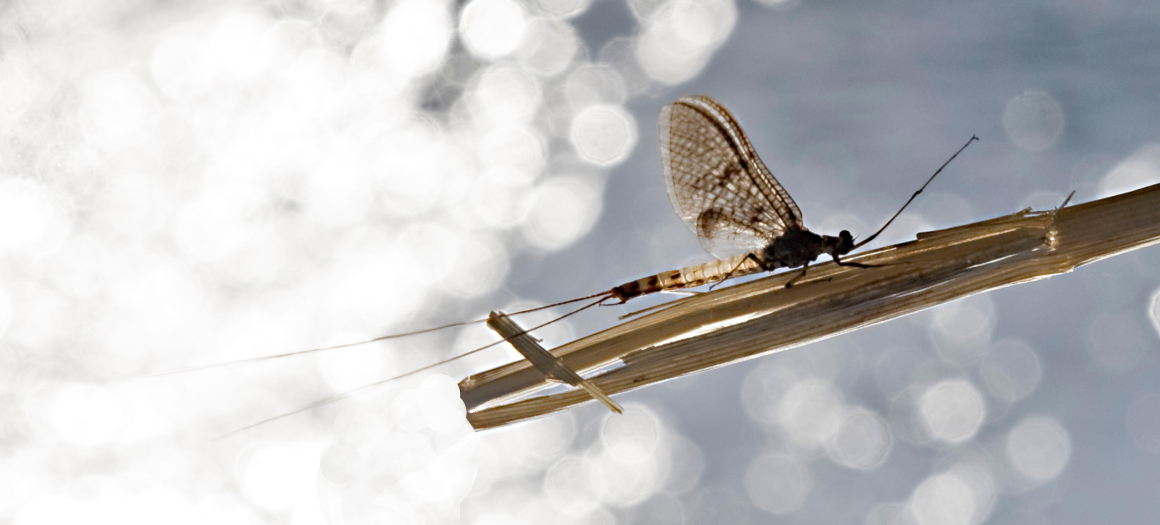
At the beginning of spring, both the longer photoperiod and increasing temperature act together as cues (triggers) for some invertebrates to end their winter dormancy (diapause) and start a rapid transformation into pupa and then adults. This leads to one of the most dramatic spectacles in our freshwaters around this time of the year: a massive, synchronised ‘peak’ where thousands of insects leave the water at once, a process known as emergence (Nash et al., 2023; Tokeshi, 1995).
This ‘spring pulse’ is not completely understood, and the response varies greatly among species and even among life stages (instars) of the same species (Finn et al., 2022).
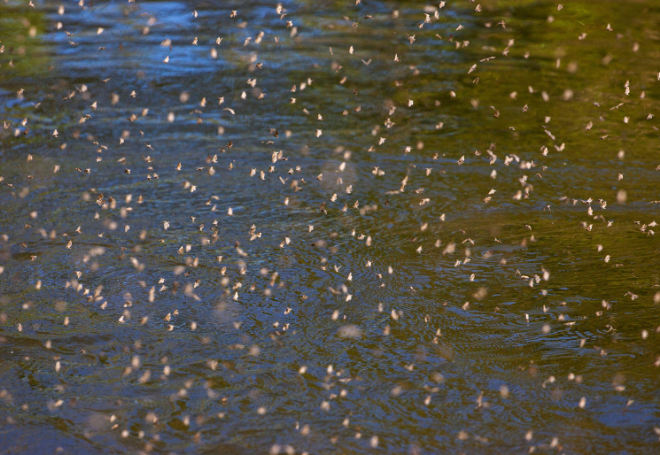
A mass hatching of Grannom fly on the River Avon in Hampshire.
The influence of climate change on aquatic insect emergence in spring
Scientists have been trying to predict the effect of climate change in freshwaters by comparing streams and ponds with a broad range of temperatures, for example in geothermal valleys in Iceland (Jackson et al., 2024), at different altitudes in mountains (Finn et al., 2022), and by conducting field and laboratory experiments with artificially heated ponds and/or water tanks (Dunning, 2017).
Predictions indicate that warmer temperatures associated with climate change will accelerate the timing of aquatic insect emergence while simultaneously increasing its duration, meaning that individuals of the same species now emerge at staggered intervals rather than in a single, synchronised burst. A long-term study spanning 42 years in European streams (Baranov et al., 2020) has already provided empirical evidence that emergence is now occurring earlier and lasting longer.
Increased growth rates driven by warmer temperatures involve a significant biological trade-off: a reduction in adult body size at emergence, up to 12% smaller according to some studies (Anderson et al., 2019). Higher temperatures also promote insect dimorphism (size difference between males and females), as females invest more resources into fecundity at the expense of growth (Bonacina et al., 2003).
Climate change might also contribute to make insect communities (and food webs) more homogenous and less diverse (Jackson et al, 2024), by promoting species with broad temperature tolerance (eurythermal) and generalist (less specialised). The EPT group (mayflies, stoneflies and caddisflies) are particularly vulnerable to this thermal selection (Bonacina et al., 2003). As an example, some studies have found that warmer temperatures reduce the ability of caddisflies to build cases, due to higher energetic cost, which leaves them exposed to predators (Mondy et al., 2011).
In the UK, rivers have already warmed, with studies in southern chalk streams indicating an increase by 1.2-1.9 °C in winter and 0.6-0.9 °C in summer over a 18-year period (1980-2006) (Durance & Ormerod, 2009). Cold-water species are reaching their thermal limits. When water exceeds a certain threshold, some species might stop feeding and suffer mass mortality (EA, 2025).
‘False springs’ and shifting seasonal events
The increasing frequency of extreme weather events is another significant impact of climate change. In the UK, record-breaking warmth in late winter (like the recent 20 °C highs seen in March) is increasingly followed by abrupt ‘cold snaps’ or ‘Arctic plunges’ (Kendon et al., 2024). This is known as ‘false springs’ and isare particularly detrimental to aquatic macroinvertebrates. While the brief period of high temperatures can prematurely trigger metamorphosis and emergence, the subsequent thermal drop might lead to high mortality rates among newly emerged adults, a topic that should be investigated further.
The emergence of aquatic insects represents a critical link between water and land (Nash et al., 2023). They are richer in long-chain Omega-3 fatty acids than terrestrial insects (especially EPT taxa: Mayflies, Stoneflies, and Caddisflies), making them a vital component in the diet of insectivorous birds (Shipley et al., 2022). However, if emergence is affected by temperature drops or takes places sooner than bird breeding (up to 20 to 40 days earlier in the U.S. according to Anderson et al., 2019), it can causes what is called a ‘phenological mismatch’: when chicks hatch, their most nutritious food source is already gone. This may be a key driver behind the 13–28% decline in insectivorous birds across Europe (Shipley et al., 2022).
Understanding environmental changes
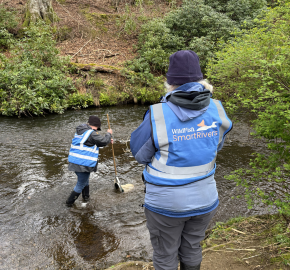
Impacts of climate change on aquatic insects are challenging, but thanks to the incredible work of SmartRivers volunteers, we are mapping population shifts across time and space at a national scale.
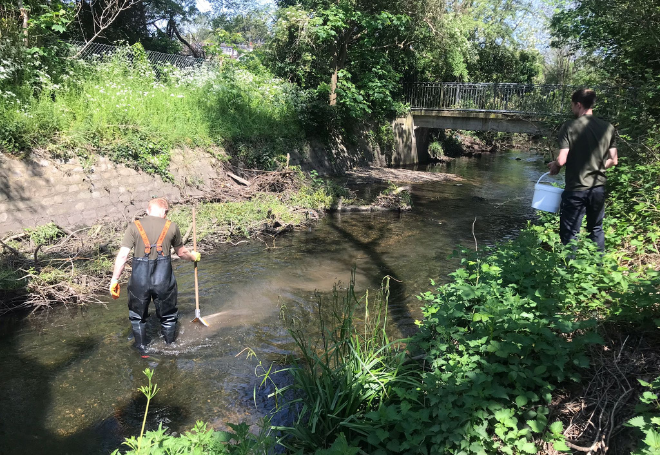
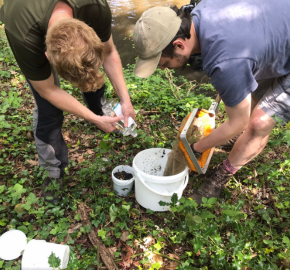
SmartRivers volunteers collect samples of aquatic invertebrates as indicators of river health. They analyse invertebrate diversity and abundance to species level helping to document population shifts over time.
Insects are incredibly plastic and can adapt to thermal changes shifting their emergence periods and producing dormant eggs that can last for years (Strachan et al., 2016), ensuring a new generation the following year if the previous has been affected by ‘false springs’. The availability of refuges in the environment can also be crucial to their survival.
We can foster these habitats by installing garden and/or allotment ponds and restoring native riparian vegetation that serves a dual purpose: their canopy provides essential shade to mitigate rising water temperatures, while their foliage offers physical surfaces where newly emerged adults can shelter from extreme weather.
Alongside these habitat improvements, maintaining high water quality remains a fundamental priority for ensuring ecosystem resilience.
Spending time by a river this spring? Keep an eye out for a small miracle: the emergence of an aquatic insect. If you are lucky, you might spot duns of Large Dark Olives (Baetis rhodani), which peak from early March to April (Elliott & Humpesch, 2010). As you watch them rise, think of the incredible journey it took to get there, from waking up after a long winter ‘sleep’ and feeding on sun-powered periphyton, to surviving drastic temperature swings and dodging predators from both the water and the sky. These small flies are a testament to the resilience of our freshwaters.
List of references
Anderson, H.E., Albertson, L.K., and Walters, D.M. (2019) Water temperature drives variability in salmonfly abundance, emergence timing, and body size. River Res. Appl. 35, 1013–1022. https://doi.org/10.1002/rra.3464
Baranov, V., Jourdan, J., Pilotto, F., Wagner, R., & Haase, P. (2020) Complex and nonlinear climate-driven changes in freshwater insect communities over 42 years. Conservation Biology, 34, 1241–1251. https://doi.org/10.1111/cobi.13477
Bonacina, L., Fasano, F., Mezzanotte, V., & Fornaroli, R. (2022) Effects of water temperature on freshwater macroinvertebrates: a systematic review. Biological Reviews, 98(1), 191–221. https://doi.org/10.1111/brv.12903
Buglife (2012) March Brown Mayfly. Available at: https://www.buglife.org.uk/bugs/bug-directory/march-brown-mayfly/#:~:text=The%20March%20Brown%20is%20probably,was%20officially%20recorded%20in%20Britain (Accessed 27 March 2026).
Dunning, H. (2017) Scientists collaborate on aquatic ecology experiments across Europe. Imperial College London News. Available at: https://www.imperial.ac.uk/news/178611/scientists-collaborate-aquatic-ecology-experiments-across/ (Accessed: 27 March 2026).
Durance, I. & Ormerod, J. (2009). Trends in water quality and discharge confound long-term warming effects on river macroinvertebrates. Freshwater Biology, 54, 388–405. https://doi.org/10.1111/j.1365-2427.2008.02112.x
Elliott, J.M. & Humpesch, U.H. (2010) Mayfly larvae (Ephemeroptera) of Britain and Ireland: keys and a review of their ecology. Scientific Publication (Freshwater Biological Association), 26: 1-58. Ambleside: Freshwater Biological Association.
Environment Agency (2025) Water temperature projections for England’s rivers. Chief Scientist’s Group Report, SC220018/R1. Environment Agency, Bristol. Available at: https://assets.publishing.service.gov.uk/media/67975defcfd3deafa04fde4b/Water_temperature_projections_for_England_s_rivers_-_report.pdf (Accessed: 27 March 2026).
Finn, D.S., Johnson, S.L., Gerth, W.J., Arismendi, I., & Li, J.L. (2022) Spatiotemporal patterns of emergence phenology reveal complex species-specific responses to temperature in aquatic insects. Diversity and Distributions, 28, 1524–1541. https://doi.org/10.1111/ddi.13472
Jackson, M.C., O’Gorman, E.J., Gallo, B., Harpenslager, S.F., Randall, K., Harris, D.N., Prentice, H., Trimmer, M., Sanders, I., Dumbrell, A.J., Cameron, T.C., Layer-Dobra, K., Bespalaya, Y., Aksenova, O., Friberg, N., Moliner Cachazo, L., Brooks, S.J., & Woodward, G. (2024). Warming reduces trophic diversity in high-latitude food webs. Global Change Biology, 30, e17518. https://doi.org/10.1111/gcb.17518
Kendon, M., Doherty, A., Hollis, D., Carlisle, E., Packman, S., Jevrejeva, S., Matthews, A., Williams, J., Garforth, J. & Sparks, T. (2025). State of the UK Climate in 2024. International Journal of Climatology, 45, no. S1: e70010. https://doi.org/10.1002/joc.70010
Minshall, G.W. (1967) Role of allochthonous detritus in the trophic structure of a woodland springbrook community. Ecology, 48, 139-149.
Mondy, N., Cathalan, E., Hemmer, C. & Voituron, Y. (2011) The energetic costs of case construction in the caddisfly Limnephilus rhombicus: direct impacts on larvae and delayed impacts on adults. Journal of Insect Physiology, 57, 197–202.
Nash, L.M., Zorzetti, L.W., Antiqueira, P.A.P., Carbone, C., Romero, G.Q. & Kratina, P. (2023) Latitudinal patterns of aquatic insect emergence driven by climate. Global Ecology and Biogeography, 32, 1323–1335. https://doi.org/10.1111/geb.13700
Shipley, J.R., Twining, C.W., Mathieu-Resuge, M., Preet Parmar, T., Kainz, M., Martin-Creuzburg, D., Weber, C., Winkler, D.W., Graham, C.H. & Matthews, B. (2022). Climate change shifts the timing of nutritional flux from aquatic insects. Current Biology, 32(6), 1342-1349.e3. https://doi.org/10.1016/j.cub.2022.01.057
Strachan, S.R., Chester, E.T., & Robson, B.J. (2016). Habitat alters the effect of false starts on seasonal-wetland invertebrates. Freshwater Biology, 61(5), 680–692. https://doi.org/10.1111/fwb.12739
Tokeshi, M. (1995) Life cycles and population dynamics. In Armitage, P.D., Cranston, P.S. and Pinder, L.C.V. The Chironomidae: Biology and ecology of non-biting midges. London: Chapman & Hall. 225-296.
Vannote, R.L., Minshall, G.W., Cummins, K.W., Sedell, J.R., & Cushing, C.E. (1980). The River Continuum Concept. Canadian Journal of Fisheries and Aquatic Sciences, 37(1), 130-137. https://doi.org/10.1139/f80-017
By: Dr Luis Moliner Cachazo
Freshwater Ecologist