Timing can be awkward. In the first week of June, the annual meeting of the North Atlantic Salmon Conservation Organization – an international inter-governmental body established in 1983 to conserve wild Atlantic salmon, will be hosted in Scotland. It momentarily puts the village of Aviemore centre stage in global efforts to reverse this species’ trajectory towards seemingly irreversible decline.
And yet as international delegates gather, Atlantic salmon populations, already listed as Endangered in Great Britain on the IUCN Red List, continue to plummet in Scotland and across much of the species’ range. Rod catches of salmon, as well as sea trout, fell to record lows last year. Two major pollution incidents on the River Spey exposed ongoing weaknesses in river protection and enforcement. Meanwhile the government’s efforts to regulate routine infestations of sea lice parasites on salmon farms (which impact wild populations) remain gridlocked by a mass legal appeal by the multi-national salmon farming industry. Some of Scotland’s other food-producing coastal businesses are now openly objecting to the expansion of salmon farms. And just two months ago, the Scottish Parliament’s Rural Affairs and Islands Committee expressed unguarded frustration about the Government’s “lack of progress in implementing recommendations that seek to protect wild salmon populations from the risks posed by farmed salmon” following its long-standing inquiry into the sector. Even some highly conservative voices within the salmon conversation movement are expressing disquiet more publicly.
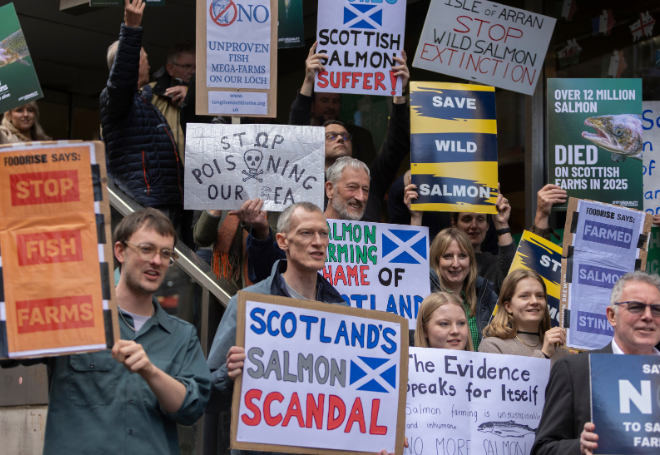
Anglers, community campaigners, and conservation groups made headlines earlier this year after they joined together at a protest against salmon farming outside Scottish parliament.
In advance of the annual NASCO meeting, each of the Parties to the Convention are expected to submit a ‘Conservation Commitments Report’ outlining the measures being taken to protect and recover salmon populations. And yet with the event being hosted here in Scotland, our Scottish Government has failed to submit one.
This is not in and of itself an ecological disaster. Our wild salmon won’t notice if a document arrives embarrassingly late. However, it reveals something about political attention and Ministerial prioritisation. An international salmon conservation meeting held in a country the government of which has not completed its own salmon conservation reporting speaks volumes about the condition of our politicians efforts to tackle the disastrous decline of salmon in Scotland.
Awareness is not the problem. The crisis facing wild salmon has been discussed extensively by scientists, fisheries managers, regulators, environmental organisations and parliamentary committees for years. The pressures are well understood: habitat degradation, pollution, impacts of salmon farming through sea lice, disease interaction and genetic introgression, barriers to migration, climate change and declining marine survival.
The problem lies with a deeper, unresolved contradiction at the heart of the Scottish Government’s policy-making.
The Scottish National Party won the recent Scottish Parliamentary elections on a focus-group-pleasing manifesto that studiously avoids recognition of some of the likely trade-offs between bullish, short-term economics and environmental stewardship.
On first pass, the incumbent First Minister’s stated desire to “grow our economy, eradicate child poverty, improve our public services, and protect our environment” gives a welcome reference to the importance of nature recovery.
The manifesto also acknowledged that “our iconic wild salmon populations are under pressure” and promised to “take actions to support wild salmon”. And yet the same government is also committed to ‘streamlining’ “consenting processes to support the ‘future of the aquaculture sector’”. Indeed the government is actively preparing the administrative and legislative architecture for the offshore expansion of salmon farming. This rests on a flawed assumption that shifting salmon farms further offshore will somehow solve the ecological issues surrounding the industry.
Meanwhile, public opinion is moving faster than government policy.
Polling commissioned by WildFish and undertaken by Survation found that more than a third of adults in Scotland believe restoring wild Atlantic salmon populations should be a “high priority” for government. 24% of Scots would be more likely to vote for a party that supports a phasing out of salmon farming to protect the marine environment and wild fish. A third of Scottish adults support a halt in salmon farm expansion, and fewer than 1 in 10 Scots believe that salmon farming should continue as it currently does.
Hundreds of people across Scotland emailed their MSP candidates in advance of the Holyrood election calling for urgent measures to protect our salmon populations.
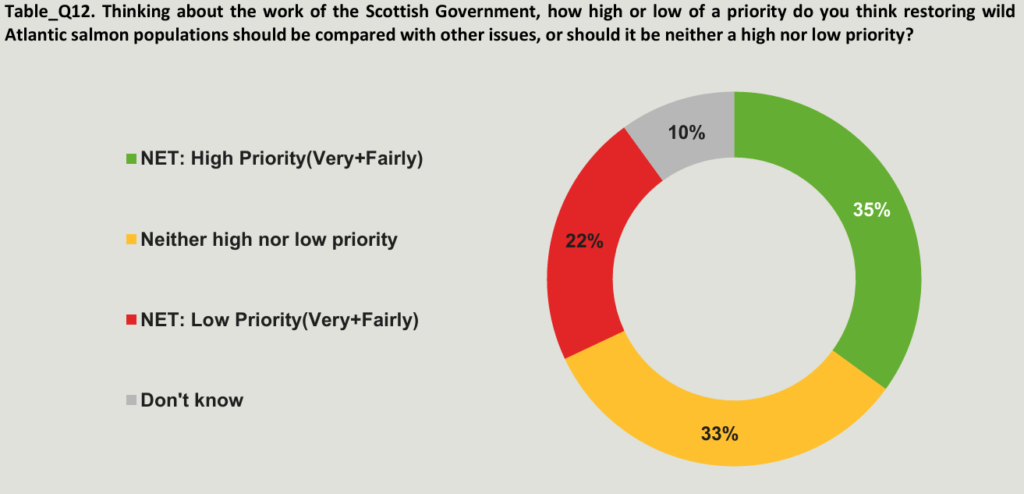
A graph showing the full responses to whether adults in Scotland believe restoring wild Atlantic salmon populations should be a “high priority” for government. Credit: Survation
The polling also revealed a striking regional divide: people living in the Highlands and Islands – where most salmon farms operate – were substantially more likely to think that salmon farms harm the environment, than people elsewhere in Scotland. The hospitality sector is also showing similar signs of concern. Through our Off The Table campaign, restaurants and chefs across Scotland and internationally are choosing to remove farmed salmon from menus because of environmental and ethical concerns surrounding its production.
The Scottish Green Party has called for a pause on new salmon farm licences – it’s an understandable response to mounting concern about salmon farming.
But the most strategic question now confronting governments internationally is larger than a prosaic debate about the pace of licensing; it is whether they will accept, as the evidence shows, expansion of open-net salmon farming is incompatible with the recovery of vulnerable wild salmon populations, or indeed the sustainable development of a rural economy.
In parts of North America, state governments have moved to remove or phase out salmon farms from key migratory corridors used by wild Pacific salmon, including in British Columbia and Washington State. Those decisions emerged because governments confronted growing concern about ecological risk and the sustainability of locating intensive open-net production systems within sensitive migratory ecosystems.
In Scotland, our government’s policy is currently being dictated by multinational companies who argue that the sector’s future primarily depends upon streamlining consenting processes, enabling innovation and facilitating further offshore expansion.
That is a fatefully narrow reading of the challenge posed. The question is no longer simply where salmon farms should be located. It is whether governments are prepared to have an honest conversation about the ecological viability of the current model itself. A growing body of research is exposing the industry-peddled myth that salmon farming is vital for food security.
In many respects, NASCO itself reflects the same wider problem. The organisation was established primarily to regulate the exploitation of salmon beyond national fishing limits. At the time, the principal concern was the overfishing of salmon in distant-water fisheries around Greenland and the Faroe Islands. Those targeted fisheries were effectively curtailed, but the broader problem of exploitation and marine mortality has never been resolved; wild salmon are still being caught as bycatch within other fisheries. There is still no comprehensive ‘Remote Electronic Monitoring’ of relevant pelagic fisheries which means we still do not have the systems in place to properly measure what is actually happening to salmon at sea.
Meanwhile, the pressures affecting wild salmon have multiplied elsewhere: habitat degradation, pollution, barriers to migration, climate change, aquaculture impacts, sea lice and disease interaction.
Parties to NASCO have responded to this by expanding the architecture of salmon governance: working groups were formed, advisory structures developed, ‘Implementation plans’ and ‘focus area reports’ emerged. Guidance documents have multiplied, with resolutions passed and endless commitments renewed. The administrative architecture surrounding the conservation of Atlantic salmon appears to grow in inverse proportion to the abundance of the fish.
WildFish recognises that important scientific cooperation continues under the NASCO umbrella, and many of the people involved are deeply serious and committed. But after four decades, at what point does a process intended to halt decline become a process for documenting decline? How many years can governments continue issuing conservation statements (or not, in the case of Scotland this year) while salmon populations continue to collapse. The credibility gap is yawning into a chasm.
A new Scottish Government now has an opportunity to decide whether wild salmon recovery is genuinely a national priority or destined to become a badge of environmental shame. We hope that the First Minister John Swinney and Gillian Martin MSP, the newly appointed Cabinet Secretary for Climate Action and Rural Affairs, will grasp this thistle and recognise the long-term, strategic value of securing healthy wild salmon populations for rural Scotland.
As campaigners, we try to look for opportunities for constructive engagement and celebration of incremental progress; positivity is a potent ingredient for political traction. But given the condition of wild salmon conservation, that optimism is simply dishonest.
We are now at a stage where the language surrounding salmon conservation becomes a form of false political reassurance detached from ecological reality. By treating procedural movement as environmental progress and failing to resolve contradictions at the heart of policy-making, we risk normalising ecological decline.
As delegates from around the North Atlantic gather in Aviemore, WildFish and the many communities that campaign for salmon conservation urge the Scottish Government and our politicians to lead by international example, and prioritise recovery of our wild salmon.
By: Nick Underdown
Director, Scotland




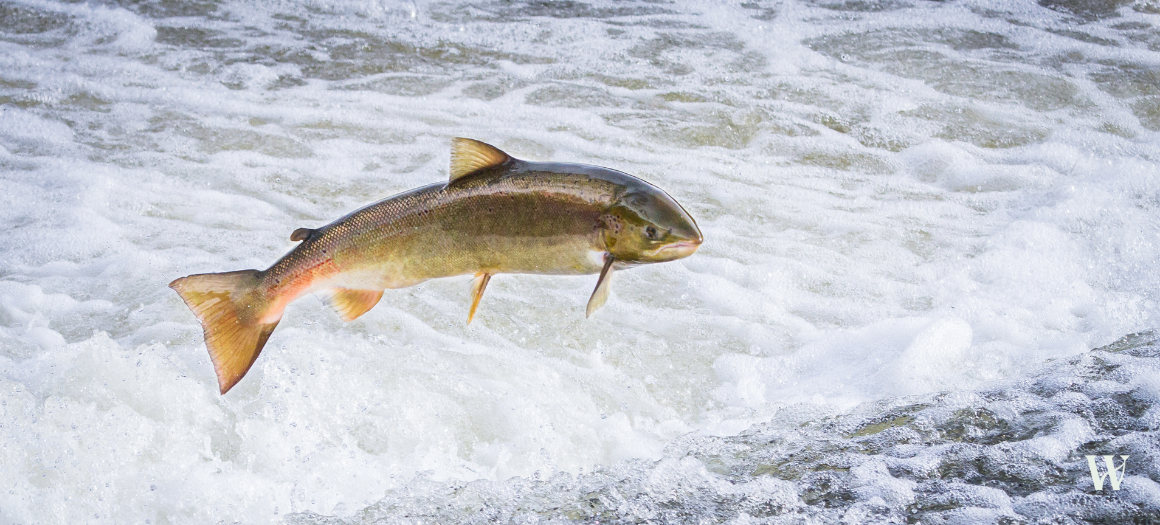

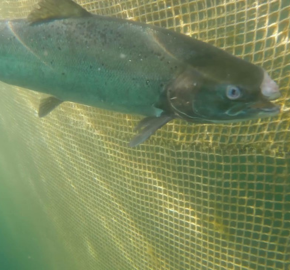
Failure to submit a conservation commitments report is an indication of the Scottish government attitude the catastrophic decline in our wild salmon river stocks.