This research by Dr Andrew King and colleagues represents a major step forward in securing the future of chalk stream salmon, providing compelling evidence that the populations inhabiting the globally rare chalk rivers, including the River Test and River Itchen, are not simply local variants of Atlantic salmon, but a distinct and highly specialised evolutionary component shaped by adaptation to the unique, stable conditions of chalk stream environments. This is critically important because it confirms these rivers support a unique genetic resource found nowhere else, strengthening the case for bespoke protection and management.
Just as significantly, the research cements the principle of ‘metapopulations’ by demonstrating that catchments such as the Test, Itchen and Meon, function as an interconnected network – with salmon moving and exchanging genetic material between rivers rather than existing as isolated populations. That evidence is especially important as drought permit and drought order negotiations progress, reinforcing the need for regulatory decisions to consider the collective resilience of these chalk stream systems rather than treating individual rivers in isolation.
In time, the paper will play a pivotal role across a wide range of conservation and regulatory processes, and formal recognition of chalk stream salmon as a distinct subspecies would provide a vital legal and scientific foundation for securing stronger protections for one of the world’s rarest and most vulnerable salmon populations.
Read on for a guest blog from Dr Andrew King, as he tells us more about this exciting new research in his own words:
Despite the best efforts of multiple organisations and agencies, populations of Atlantic salmon have continued to decline across their entire range, with –according to the North Atlantic Salmon Conservation Organization (NASCO) – the majority of populations now at high risk of local extinction. The International Union for Conservation of Nature (IUCN) have recently updated the conservation status of Atlantic salmon, downgrading the species globally to near threatened, with the salmon populations of Britain classified as endangered and the English chalk stream sub-population categorised as vulnerable. For England and Wales, the latest stock assessment (from 2024) showed that only seven rivers (out of the 58 that were assessed) were above their Conservation Limit. A combination of man-made stressors in both freshwater and marine environments, such as habitat degradation, pollution, water abstraction and climate change, has contributed to this decline.
In this context, the salmon populations inhabiting the chalk streams of the Hampshire Basin are of particular interest. Chalk streams are a globally rare habitat. Of the 200 or so chalk streams known globally, some 85% are found in southern and eastern England, with the remaining rivers found in northern France, Denmark and New Zealand.
We have known for some time that the salmon inhabiting the chalk streams of the Hampshire Basin are genetically distinct from those in non-chalk rivers in the rest of Britain, Ireland and mainland Europe. Likewise, salmon from the chalk rivers of Upper Normandy have been shown to be distinct from all other non-chalk French rivers. However, until now, no study has looked at both these two sets of chalk salmon together.
As part of the SAMARCH project, at the University of Exeter and in collaboration with a researcher in France, we have recently published a paper that did just that – analysed Hampshire Basin and Upper Normandy salmon in the same study. We sampled fish from 42 rivers, primarily from southern Britain and northern France and supplemented these with salmon from rivers flowing into the Irish Sea and the North Sea. We investigated the levels and patterns of genetic diversity using data from a suite of 93 genetic markers located across the salmon genome, and, to identify populations of greatest conservation interest/concern, we assessed the importance of each river to overall genetic diversity.
Initially, we found that there were four main regional groupings of rivers, namely English chalk, French chalk, English non-chalk, French non-chalk populations. We confirmed that the chalk salmon of southern England and northern France are divergent from non-chalk salmon and that they form a distinct grouping, quite different from all the other populations that we analysed (Figure 1). Diving into the data, we found that the frequency of some of the genetic markers in each river was closely associated with environmental data, suggesting that the differences between chalk and non-chalk salmon is likely due to local adaptation – a process whereby over many generations populations become better suited genetically to their local environment.
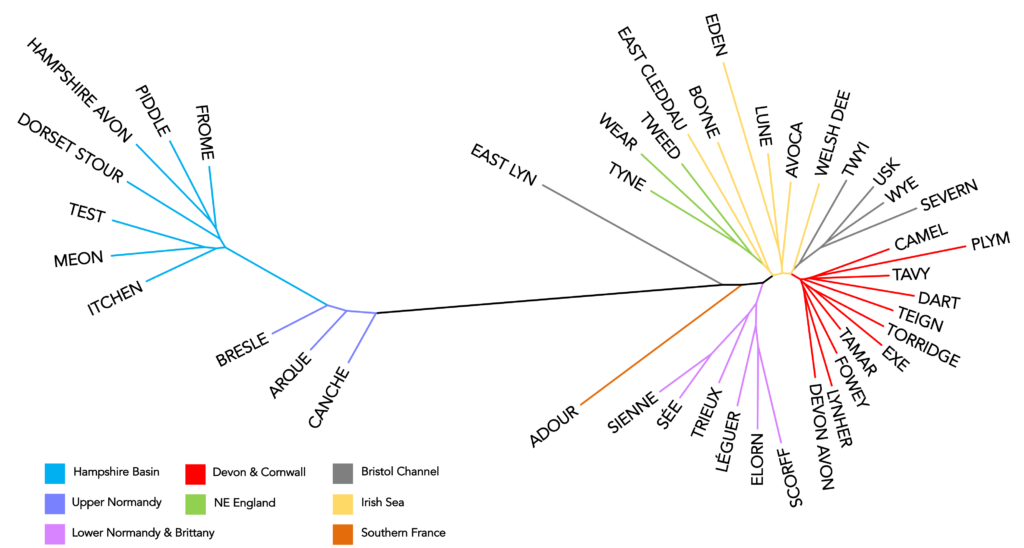
Figure 1 – genetic relationships between 42 Atlantic salmon rivers. Branches are colour coded by geographical location.
However, there are some differences between UK and French chalk salmon. For instance, the Upper Normandy rivers had higher levels of diversity than Hampshire Basin populations and we found that this was most likely related to a lingering signature of historical stocking: for many years, the rivers of Upper Normandy were heavily stocked from donor rivers mainly on the east coast of Scotland. The genetic signal of this stocking persists today, with French chalk salmon still showing a marked level of non-chalk ancestry.
Within each of the four main groupings we found that, generally, there are low levels of differentiation between rivers. For example, some rivers were shown to be genetically virtually identical, i.e. Frome & Piddle and Test & Itchen. Anadromous salmonids typically form metapopulations, where rivers are connected by varying levels of migration, via straying, between them. For instance, increased straying has been found between Canadian Atlantic salmon rivers with similar water chemistry profiles. Given that all the Hampshire Basin rivers originate from the same chalk aquifer system, the low divergence between these rivers likely reflects a high degree of chemical similarity of the water in each of the Hampshire Basin rivers, with ‘frequent’ straying of fish between catchments.
Additionally, we demonstrated that the chalk salmon, and especially those from the Hampshire Basin rivers have high conservation value. The seven UK chalk stream rivers had the lowest levels of genetic diversity, being lower than the majority of other rivers we studied, and our analyses showed that loss, i.e. local extinction of chalk stream salmon, would result in an overall decrease in levels of genetic diversity within Atlantic salmon of approx. 6%.
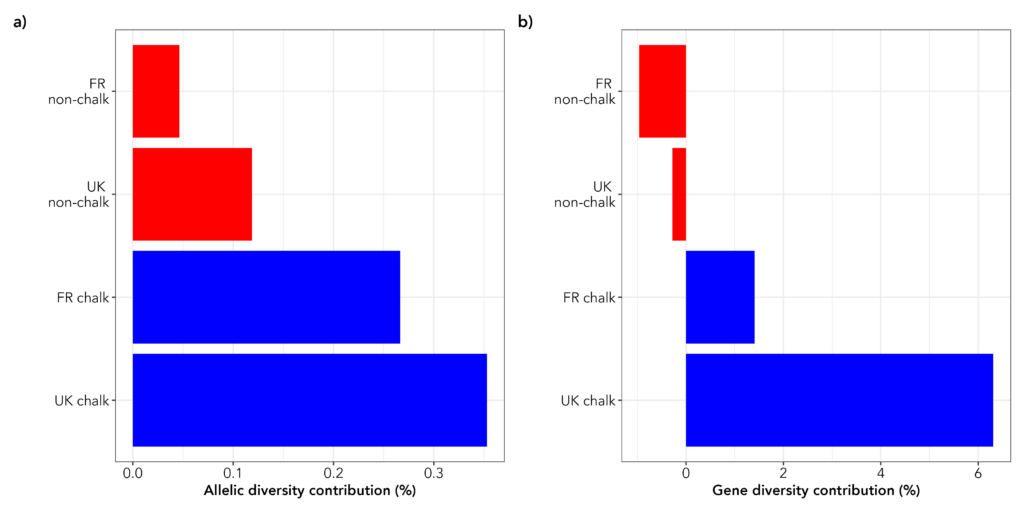
Figure 2 – Conservation priorities for Atlantic salmon. Contribution of four regional groups of rivers to total a) allelic and b) gene diversity. Non-chalk regions are shown in red and chalk regions in blue. A positive contribution shows what would be lost from the species if that grouping was to be lost, i.e. local extinction.
Overall, the results of our study would suggest that the Atlantic salmon rivers studied could be classified as two distinct Evolutionarily Significant Units (ESUs) – chalk and non-chalk. An ESU is a group of populations that merit separate management and conservation as a consequence of genetic, ecological and geographical distinctiveness. However, the same criteria that are used to define an ESU are similar to those that have been used to delimit subspecies, and we have suggested that the chalk salmon could be recognised as a distinct subspecies within Salmo salar – namely S. salar calcariensis.
It is important to recognise the ways that genetic data are used in wildlife conservation and management in different countries. Unlike wildlife protection legislation in the USA and Canada, ESUs are not currently recognised in the UK Habitats Directive, the main legislation responsible for conservation of species and habitats in the United Kingdom. However, subspecies can be specified in the Habitats Directive and in the case of chalk stream salmon, we anticipate that their formal designation as a distinct subspecies could in fact benefit their conservation more than being designated as an ESU. However, more extensive studies are needed to fully address the intraspecific taxonomy of salmon in this region.
The paper, published in the journal Evolutionary Applications, is available Open Access and is entitled: “The chalk streams of southern England and northern France harbour substantial unique components of the overall genetic diversity of Atlantic salmon (Salmo salar L.).”
The SAMARCH project (www.samarch.org) was a multi-agency collaboration between researchers in England and France to investigate various aspects of the biology of English Channel populations of Atlantic salmon and sea trout with a view to providing much needed information for their conservation and management.