We have looked at how barriers harm fish, blocking migrations, degrading water quality and fragmenting habitats that once stretched uninterrupted from source to sea. But these structures didn’t appear from nowhere. Britain’s rivers have been put to work for millennia, and many of the barriers we are dealing with today are the legacy of industries and ways of life that have long since changed or disappeared entirely.
So why were they built? Our campaigns researcher, Danny Nixon, explores this and asks: Which ones do we still genuinely need?
Before you get stuck in, have you signed our handraiser to show your support for reconnecting rivers? Follow the link below to add your name today.
ADD MY NAME
Five thousand years of barrier building
River barriers are not a modern invention. The oldest known dam was built around 3000 BC at the Bronze Age settlement of Jawa in Jordan. In Britain, our rivers have been dammed, diverted and controlled for thousands of years.
But it was the Industrial Revolution that transformed the scale of barrier construction beyond recognition. Britain’s rivers became the engine of the world’s first industrial economy, powering mills, supplying canals, feeding reservoirs and providing the water infrastructure on which expanding cities depended. From the Pennines to South Wales, and from Lancashire to the Midlands, the rivers that ran through our industrial heartlands were put to work in ways that required extensive physical modification.
Man-made barrier density is highest in historically industrialised areas, including Greater Manchester, the Midlands, South Wales, and West Yorkshire. The Mersey catchment alone contains nearly 2,900 man-made barriers, a density of 1.14 per square kilometre. In parts of South Wales, that figure rises even higher.
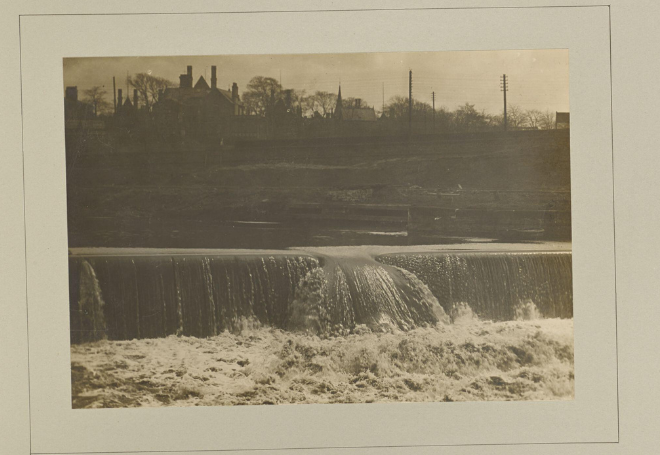
Image 01: This Weir in Manchester, situated immediately above Trafford Road Bridge, formed part of the old Mersey and Irwell Navigation System. ©Alamy
The barriers we still need
Before talking about which barriers should be removed, it’s important to be realistic about the structures we still depend on. The case for barrier removal is not a case against all river infrastructure. It’s about being smarter and more targeted when deciding which structures are genuinely necessary.
Some barriers remain essential to modern life in the UK. Here’s why:
- Drinking water: Large reservoir dams are critical infrastructure for public water supply, particularly in densely populated areas where demand outstrips supply. Over 480,000 million cubic metres of extra water per year will be needed to meet expected population growth by the 2050s, and we have not built a new reservoir since 1992 – that’s over 30 years ago. We should expect and welcome new reservoir construction to maintain our drinking water supply.
- Flood protection: Many urban areas are built on floodplains, and the barriers that help manage flood risk in these communities cannot simply be removed without alternatives in place. As climate change increases the frequency of extreme rainfall events, the role of flood management infrastructure will only grow. In England, over five million, or one in six properties, are at risk of flooding (Environment Agency, 2009). In many cases, flood defence structures in rivers are part of what keeps them safe.
- Navigation: Locks and sluice gates on navigable canals and rivers are important for recreation, tourism and in some cases commercial transport. Many are also part of the historic fabric of our waterways, with protected status and deep ties to local identity.
In many cases, the same structure serves multiple purposes simultaneously, making removal complicated. A weir that is technically ‘redundant’ in industrial terms may still influence flood management downstream, or may have become part of a local ecosystem in ways that complicate simple removal.
That said, reconnecting our rivers is essential to the future of wild fish – particularly migratory species whose life cycle depends on connected waters.
The barriers we might not need anymore
A significant proportion of barriers in our rivers serve no meaningful purpose today.
It is estimated that around 150,000 of Europe’s approximately 1.2 million recorded barriers are now obsolete, no longer fulfilling their original purpose (Dam Removal Europe, 2022).
In the UK, some datasets have suggested up to 20% of recorded barriers are no longer in active use (Rivers Trust, 2025). The true figure may be higher, as information on barrier usefulness is poorly recorded. In most UK barrier datasets, this field was left blank or marked unknown for the vast majority of structures.
WildFish’s analysis has shown that the most common barrier types in the UK are not large dams but culverts (62% of all artificial barriers) and weirs (28%). Many of these are small, old, and connected to industries that ceased operating decades ago. Former mill weirs on rivers across the Pennines, old industrial culverts beneath urban streets, and agricultural diversions from a different era of farming. Thousands of these structures are now sitting in our rivers, blocking fish and trapping sediment, with no one who relies on them and no reason for them to stay.
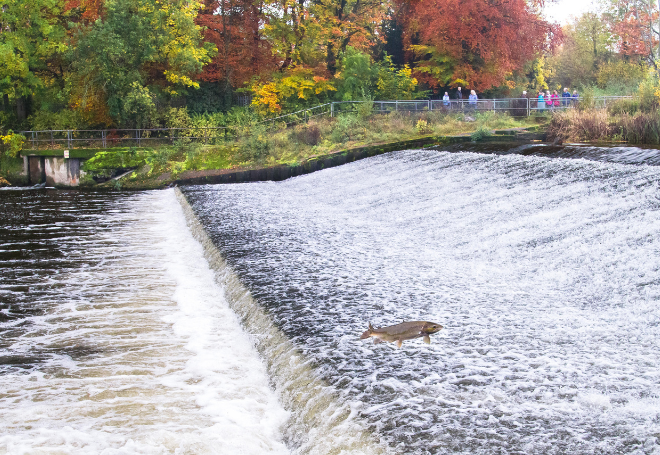
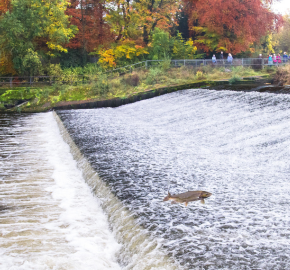
Image 02: An Atlantic salmon jumps out of the water in an attempt to pass the Shrewsbury weir on the River Severn. ©Alamy
There’s also a practical financial argument for removal. Many of Britain’s concrete dams and weirs were built in the early twentieth century with design lives of around 100 years. They are now approaching or past that lifespan, and ageing infrastructure requires regular, costly inspection and maintenance. In many cases, removing a structure entirely is cheaper in the long run than keeping it in place, and delivers ecological benefits that maintenance never could.
Europe is acting, but is the UK falling behind?
Across Europe, there is growing momentum behind barrier removal as a mainstream river restoration tool. In 2023 alone, 487 barriers were removed across 15 European countries — a 50% increase on the previous year. France removed 156, Spain 95, Sweden 91, Denmark 72 (DRE, 2024). The UK removed just 36.
The EU’s 2030 Biodiversity Strategy has set a target of making at least 25,000 km of rivers free-flowing again by 2030, primarily by removing obsolete barriers. Good progress has been made; in 2024, over 2,900 km of river connectivity was restored.
But the UK, no longer bound by EU targets following Brexit, has no equivalent strategic plan. The UK’s National Biodiversity Strategy and Action Plan contains no specific mention of river barriers and no target for restoring river connectivity.
This is a significant gap. Without a national strategy that identifies priority barriers, allocates dedicated funding and sets measurable targets, barrier removal in the UK will remain patchy and slow. Instead, it will be driven by the efforts of individual river trusts and conservation organisations rather than the coordinated, catchment-scale action the problem demands.
Identifying the right barriers to remove
Not all barrier removal is equal. The most effective approach targets the structures where removal will deliver the greatest ecological benefit.
One key concept is ‘passability’ – the percentage of fish that can successfully navigate past a given obstacle (Buddendorf et al., 2019). Passability depends on the type and height of the barrier, the target species, the flow conditions and, critically, the position of the barrier relative to others in the river. A single impassable barrier near the sea can cut off the entire upstream habitat from the marine environment. Removing it may unlock far more river than removing ten barriers higher up the catchment.
Research on the Tagus River in Spain found that removing just seven of twenty-nine barriers, identified through habitat modelling, could improve river connectivity by as much as 37% (Branco et al., 2014).
The message is clear: strategic and targeted removal delivers far more than random or opportunistic action – highlighting the need for a clear strategy in the UK.
What success looks like
When barriers do come down, rivers respond and fish return. Complete, large-scale removal is not always possible. Smaller-scale efforts can still have a positive impact, including:
1. Fish passage solutions
When trying to reconnect river habitats, complete removal of all barriers may not be possible, but removing just some obstructions and installing fish passage solutions can still have a great effect.
On the River Deerness (a tributary of the River Wear) in Northeast England, three barriers were removed, five barriers fitted with fish passes, and two barriers left unaltered between 2013 and 2019. Total fish abundance, comprising seven native species, increased three years after the restoration project and remained elevated to the end of the study (Sun et al., 2022).
An increase in habitat connectivity reduced the mean age of brown trout, suggesting a change to an increased migratory component of the population, showing the benefits barrier removal brings to resident fish species as well as migratory ones. Immediate geomorphic benefits observed included large increases in riffle habitats essential for salmonid spawning and decreased fine sediment loads. The study highlighted the immediate ecological benefits of connectivity restoration, especially in rivers with many barriers, but larger scale changes may take several years to develop.
2. Small-scale removal
Barrier removal does not have to be a large, expensive project to provide real ecological benefits. The majority of UK barriers are small obstructions, such as culverts, sluice gates and fords, many of which can be removed at low costs with simple solutions.
At Staindale Beck, in North Yorkshire, a concrete sleeper ford, installed over 30 years ago, was likely impassable to the majority of fish in the majority of flow conditions and was no longer in use by the landowner (Forestry England) after the installation of a bridge. The ford negatively impacted geomorphological conditions within the beck, with the channel impounded 25m upstream, creating a large area of unnaturally deep and slow-moving water and increased fine sediment deposition. Whilst the planning by Yorkshire Wildlife Trust took approximately four months to complete, the actual removal work carried out by a local contractor with an excavator took only one hour at the cost of £385!
These are not isolated success stories. They reflect what a growing body of international evidence consistently shows: barrier removal works, and it works faster than almost any other river restoration intervention. Fish respond quickly, and habitats recover. The ecological return on investment is high.
Take the Morton Quarry Weir in Linhouse Water, West Lothian. The two-metre structure, dating from the 1800s oil shale industry, was removed by the Forth Rivers Trust in 2023 (Mouchlianitis, 2024). The result was 8.5 kilometres of spawning habitat unlocked for wild fish upstream. Trout and salmon were observed attempting to migrate upriver even while the removal was still underway!
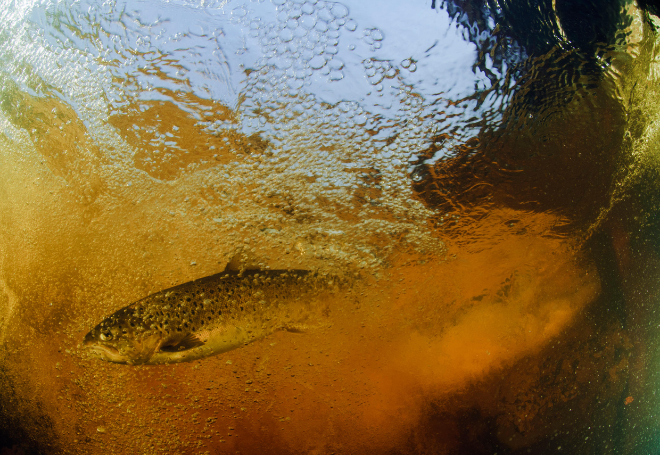
Image 03: A brown trout navigates turbulent water at a weir on the River Ettick in Scotland. ©Alamy
What WildFish want to see
In the UK, we have more than 70,000 recorded barriers, and possibly well over 100,000 in reality. Most of these barriers are man-made, and a significant proportion of them no longer serve any purpose. Meanwhile, four of our seven most endangered freshwater fish species are in decline partly because of those barriers. This is no surprise when far less than 1% have any fish passage provision.
We want to see:
- A national strategy for barrier removal, with dedicated funding and clear targets for restoring river connectivity — equivalent to the ambition shown by European neighbours.
- Priority given to removing obsolete barriers first — the structures with no current use and the greatest ecological impact.
- The long-awaited Fish Passage Regulations, drafted in 2009, finally brought into law, giving legal force to the requirement for fish passage at historical barriers where removal is not feasible.
- Better data on barriers, especially usefulness, so that the scale of the ‘redundant barrier’ problem can be properly quantified and acted on, and barriers can be assessed for priority removal.
Our rivers were once among the most productive salmon and eel rivers in Europe. That can be true again, but we need to address the main threats. Reducing habitat fragmentation by removing obsolete barriers and reconnecting our rivers is key and should be considered alongside reducing pollution and abstraction in a holistic approach to river conservation.
List of references
- Branco, P., Segurado, P., Santos, J. M., & Ferreira, M. T. (2014). Prioritizing barrier removal to improve functional connectivity of rivers. Journal of Applied Ecology, 51(5), 1197–1206. https://doi.org/10.1111/1365-2664.12317
- Buddendorf, W. B., Jackson, F. L., Malcolm, I. A., Millidine, K. J., Geris, J., Wilkinson, M. E., & Soulsby, C. (2019). Integration of juvenile habitat quality and river connectivity models to understand and prioritise the management of barriers for Atlantic salmon populations across spatial scales. Science of The Total Environment, 655, 557–566. https://doi.org/10.1016/j.scitotenv.2018.11.263
- Dam Removal Europe. (2022, May 15). Record breaking year for dam removals in Europe. Progress Report 2021. https://damremoval.eu/report-2021/
DRE. (2024). Dam Removal EU. About Us. https://damremoval.eu/about/
- Environment Agency. (2009). Flooding in England: A National Assessment of Flood Risk. https://assets.publishing.service.gov.uk/media/5a7ba398ed915d4147621ad6/geho0609bqds-e-e.pdf
- Hölker, F., Jechow, A., Schroer, S., Tockner, K., & Gessner, M. O. (2023). Light pollution of freshwater ecosystems: Principles, ecological impacts and remedies. Philosophical Transactions of the Royal Society B: Biological Sciences, 378(1892), 20220360. https://doi.org/10.1098/rstb.2022.0360
- Mouchlianitis, F. (2024). Dam Removal Progress 2023. World Fish Migration Foundation. https://damremoval.eu/wp-content/uploads/2024/04/Web-version_DRE-Report-2023.pdf
- Pérez Vega, C., Jechow, A., Campbell, J. A., Zielinska-Dabkowska, K. M., & Hölker, F. (2024). Light pollution from illuminated bridges as a potential barrier for migrating fish–Linking measurements with a proposal for a conceptual model. Basic and Applied Ecology, 74, 1–12. https://doi.org/10.1016/j.baae.2023.11.001
- Rivers Trust. (2025). Barrier Removals. The Rivers Trust. https://theriverstrust.org/about-us/our-position-statements/barrier-removals
- Sun, J., Tummers, J. S., Galib, S. M., & Lucas, M. C. (2022). Fish community and abundance response to improved connectivity and more natural hydromorphology in a post-industrial subcatchment. Science of the Total Environment, 802, 149720.
By: Daniel Nixon
Campaigns Researcher





Remember our rivers teemed with Salmon 17- 20th century. Weirs can be beneficial – oxygenation downstream and deeper resting pools upstream. Current obsession with Lariniere passes against old fashioned but simple baulk passes, has shown me how infection caused through the wretched baffles causing abrasion and subsequent infection has just about wiped out our salmon stock here on the river Exe. I can speak from experience as I have been here for 40 years and been a salmon fisherman for 68 years. I f near Exeter you are welcome to come and see me. Ian Cook, Weircliffe House Exwick Exeter EX4 2AF
Hi Ian, thanks for your observations.
On fish passes, you’re right to flag that many designs have problems. Baffled passes, including Larinier designs, can cause abrasion injuries in fish under certain conditions. However, we see both Larinier and baulk passes as “last resort” solutions rather than the goal itself. Baulk passes offer poor downstream fish passage and are more selective toward stronger-swimming species. When barrier removal isn’t possible and the site allows, our preference is a natural bypass channel. These tend to cause the least physical damage and stress to fish while also better mimicking a natural river environment, allowing the best possible chance for fish species to successfully navigate the barrier.
On weirs, it’s true that some weir designs can aerate water locally, but any oxygenation benefit tends to be limited in extent downstream, and it’s often offset by sedimentation building up behind the weir, which reduces dissolved oxygen upstream. Similarly, any upstream benefit from resting pools must be weighed against increased scour and habitat loss immediately downstream of the weir, plus the way sedimentation degrades habitat upstream. Taken together, we don’t think weirs offer a net benefit once you look at the whole stretch of river affected, rather than just immediately upstream and downstream of a barrier.
We think barriers need to be assessed for their effect on the catchment as a whole, not just the local stretch immediately around them. A weir or pass that looks beneficial in isolation can still be a net negative once you account for its effects both upstream and downstream. Furthermore, multiple barriers in a catchment will amplify these issues, so it is best to first look at what we can remove before then finding the most suitable fish passage solution.
The WildFish Team.