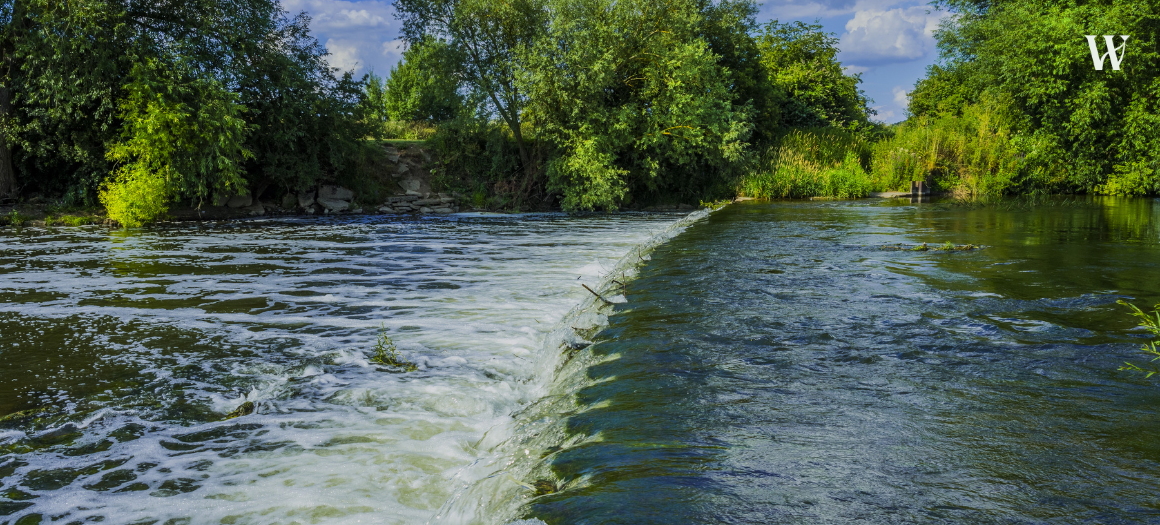
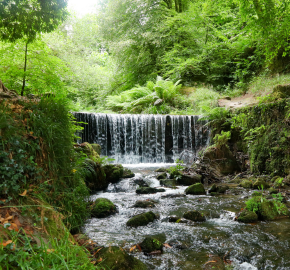
The streams and rivers of the UK form a network of interconnected highways for migratory fish. But from time immemorial, we have been creating barriers to manage water, create sources of energy, drive machines or even to trap fish.
Manmade barriers therefore need regulating – which was clear even as far back as the Magna Carta which mandated the complete removal of multiple weirs often built to trap fish: “all fish-weirs are in future to be entirely removed from the Thames and the Medway, and throughout the whole of England, except on the sea-coast”.[1] Of course the Royal intention was to restore navigable rivers – not to assist fish-migration!
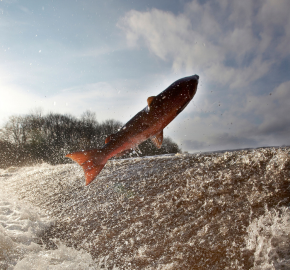
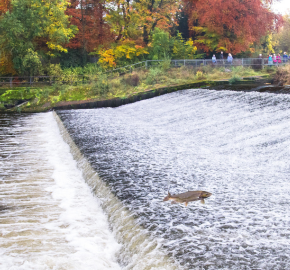
But whether that decree was effective at the time, barriers including weirs remain a huge problem. Fish that need to migrate up-river to spawn are halted in their paths and cannot complete their life-cycle. Some fish may find ways around the obstacles; but with other pressures and falling salmonid populations, these things just cannot be left to luck – so, clearly, something needs to be done. And that is not just for ecological reasons.
That is because making rivers accessible for fish is set out clearly in our present laws. UK rivers are failing to meet ecological targets set out in European-derived law. The reasons for the failure include water quality and quantity, but also the physical barriers that stop salmon and sea trout from migrating to access breeding, nursery and feeding grounds.[2] At the same time, migratory Atlantic salmon have been added to the “Red List” meaning they are at risk of extinction.[3]
In way of explanation, the Water Framework Directive (WFD), implemented in England and Wales by the Water Environment (Water Framework Directive) (England and Wales) Regulations 2017, obliges the UK to set targets or objectives for achieving good ecological status (GES) for waterbodies by 2027.[4]
Those obligations are repeated under regulation 3 of the WFD Regulations in England (with similar wording in the Scottish and Northern Irish legislation) stating that the “Secretary of State, the Welsh Ministers, the Agency and NRW must exercise their relevant functions so as to secure compliance with the requirements of the WFD. . .”. The functions include permitting and authorisations, with the aim of preventing deterioration of waterbodies and achieving the environmental objectives.
The environmental objectives – of GES or Good Ecological Potential (GEP – for heavily modified waterbodies) – are made up of biological, physico-chemical and hydromorphological quality elements; the hydromorphological element being the key one here as it covers the connectivity of rivers for migratory fish.
Annex 5 of the WFD explains that “high” status for a waterbody would require “ . .River continuity. . .not disturbed by anthropogenic activities and allows undisturbed migration of aquatic organisms and sediment transport”
The information that enables the authorities to decide what action to take in reaching GES is supposed to be set out in the Programme of Measures (PoM) in the RBMPs (Regulation 12 in the English/ Welsh Regulations).
However, what tends to happen is that very little detail is included in the PoMs for the various catchments[5] and the EA relies on exceptions to the target for GES including “technical infeasibility” and “disproportionate expense” – which means that even if there is mention of the particular pressure, the appropriate measures are either too expensive or too difficult to carry out (e.g. weir removal).
Hence the need for a change to domestic law – as a means for the more expeditious removal of weirs and inclusion of fish passes – and as a viable “measure” to comply with the WFD.
But, right now, with the threat that WFD law will be changed (perhaps to soften its targets) the government seems to have given up on complying with its WFD obligations.
Back in 2009, things were looking more hopeful: a consultation was held by DEFRA on “the modernisation of salmon and freshwater fisheries legislation; new order to address the passage of fish”. The consultation promised changes to the law with requirements for fish passes , drafted to enable the UK to meet its WFD obligations and to comply with the EU Regulation 1100/2007). The government proposed to introduce legislation supported by the Environment Agency and Natural England. In fact, the Environment Agency were clear that “Without intervention, governments will be unable to address the improvements in fish passage required to meet their WFD and EU Eel Regulation obligations”. At the time of the consultation and before the EA’s resources were being squeezed, it said that meeting a phased implementation by 2027 “is realistic”.
Yet the proposed legislation never saw the light of day despite promises made by successive governments.[6]
In 2025, WildFish complained to the Office for Environmental Protection (OEP) due to Defra’s unwillingness to put in place the solution to the problem via new regulations. The OEP then decided to investigate Defra’s failure to deal with barriers to fish migration in English rivers.[7]
The good news is that the OEP agrees with WildFish that there is a “potential failure by the EA and Defra to comply with Regulations 3 and 12 of the [ WFD] Regulations” as the PoMs “do not properly address blockages preventing fish passage.”
The OEP has therefore written to the EA and Defra, giving them 2 months to respond, and asking them to confirm that their draft River Basin Management Plans (RBMPs) “will include sufficient measures to be applied to remedy blockages within rivers which may prevent fish passage”.
WildFish understands that conversations between OEP and Defra as well as the EA continue –and that the EA’s current position as expressed in 2009 is virtually the same (i.e. that the EA needs changes to the law to comply with WFD obligations and funding to support work on removing barriers). Whether the OEP intervention will result in legal action remains to be seen.
In the meantime, we will continue to press for change and will look carefully at the forthcoming draft RBMPs to see whether they contain enough substance to ensure that the status quo changes.
List of references
- See Clause 33 of the Magna Carta – Magna Carta Project – 1215 Magna Carta – Clause 33.
- There are an estimated 0.75 barriers per 1 km of river in Great Britain, and only 1% of rivers are free of artificial barriers, with an estimated 28,000 man-made barriers in England and Wales, of which about 19,000 are weirs, with the remaining being a selection of dams, culverts, locks and sluices.
- The situation is so bad that Atlantic salmon were added to the IUCN Red List of Threatened Species as “Endangered” in 2023, after campaigning by WildFish. Freshwater fish highlight escalating climate impacts on species – IUCN Red List – Press release | IUCN.
- Implemented in Scotland by the Water Environment and Water Services (Scotland) Act 2003 and the Water Environment (River Basin Management Planning) (Scotland) Regulations 2013: and in Northern Ireland by the Water Environment (Water Framework Directive) Regulations (Northern Ireland) 2017).
- The high level, PoM was the focus of recent successful litigation taken by Fish Legal on behalf of the Pickering Anglers in Secretary of State for Environment, Food and Rural Affairs v Pickering Fishery Association, R (On the Application Of) & Anor [2025] EWCA Civ 378 [02 April 2025].
- DEFRA’s Impact Assessment of measures to address obstructions to the free passage of migratory and freshwater fish from 2009 can be found at [ARCHIVED CONTENT].The sad history of this affair is that While the Eel (E&W) Regulations 2009 were passed, the Better Regulation Executive identified as the proposed wider Fish Passage Regulations, for WFD purposes, as a measure to be delayed until May 2011. The Government’s 2010-2015 Policy paper on freshwater fisheries1 later reported that “we intend to introduce new laws to help salmon and other freshwater fish migrate upstream and downstream. By 2016, the Government had again resurrected the plan for regulations, In the 2016 Salmon Five Point Approach was signed committed to deliver new fish passage regulations in 2017. In its 2019 Report to NASCO2, the UK reported that “the government remains committed to delivering fish passage legislation, after the transition period”. December 2023, International Union for the Conservation of Nature, which administers the IUCN Red List of Threatened Species, altered the official status of the main UK population of Atlantic salmon, reclassifying the population as Endangered, signalling that the UK populations are at risk of extinction.
- Letter from OEP to WildFish – “Complaint about Department for Environment, Food and Rural Affairs (Defra) “ dated 9 January 2026.
By: Justin Neal
Solicitor